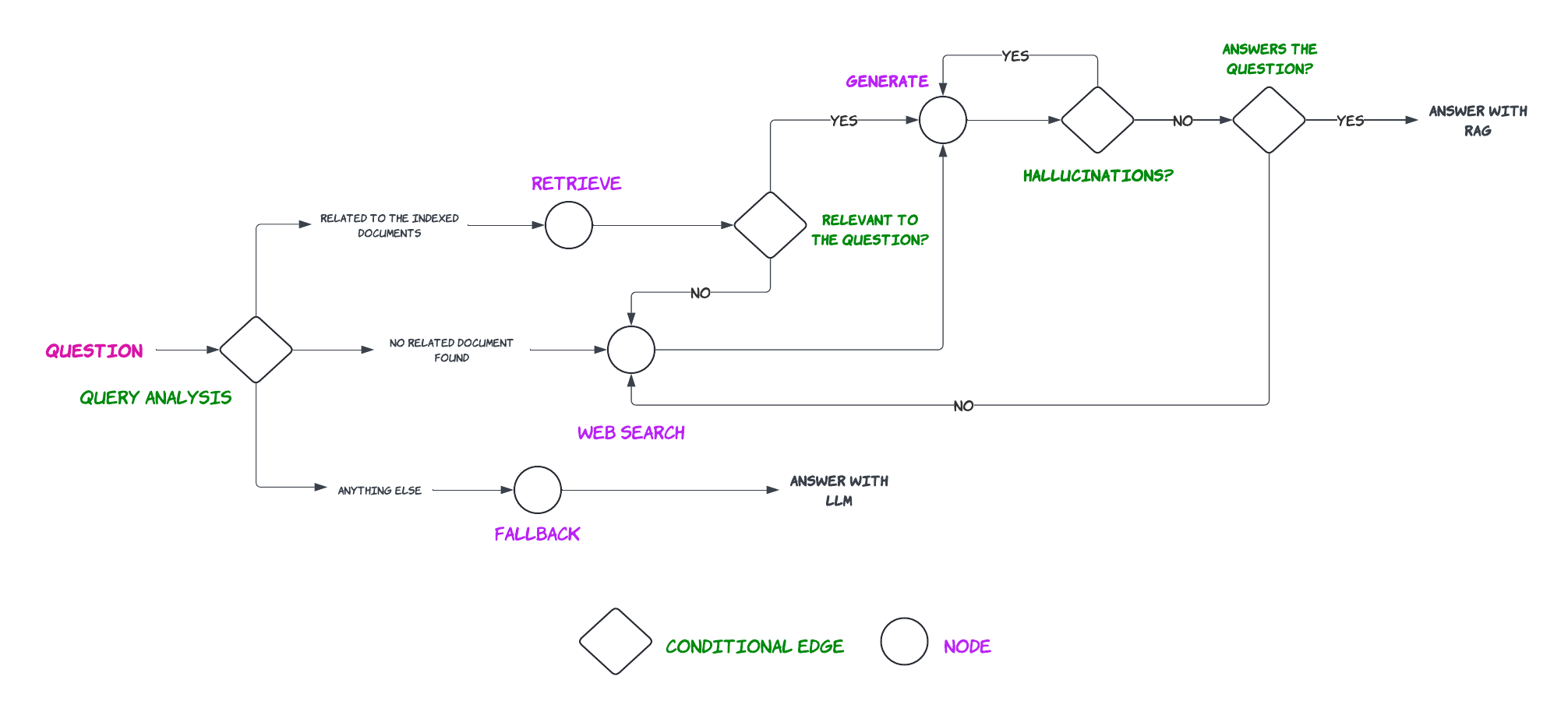
In this section we improve the previous CRAG implementation by adding “Query Analysis” as described in Self-RAG and Adaptive RAG papers, according to the following graph.
 |
|---|
| Improved RAG pipeline with Query analysis and Self-RAG |
%load_ext dotenv
%dotenv secrets/secrets.env
from langchain_text_splitters import RecursiveCharacterTextSplitter
from langchain_community.document_loaders import WebBaseLoader
from langchain_community.vectorstores import Chroma
from langchain_openai import OpenAIEmbeddings
from langchain_openai import ChatOpenAI
from langchain_core.prompts import ChatPromptTemplate
from langchain_classic import hub
from langchain_core.output_parsers import StrOutputParserWe start by creating our retriever to retrieve documents (documents about agents, prompt engineering, and adverserial attacks on llms) from the vectorstore.
urls = [
    "https://lilianweng.github.io/posts/2023-06-23-agent/",
    "https://lilianweng.github.io/posts/2023-03-15-prompt-engineering/",
    "https://lilianweng.github.io/posts/2023-10-25-adv-attack-llm/",
]

docs = [WebBaseLoader(url).load() for url in urls]
docs_list = [item for sublist in docs for item in sublist]

text_splitter = RecursiveCharacterTextSplitter.from_tiktoken_encoder(
    chunk_size=250, chunk_overlap=30
)
doc_splits = text_splitter.split_documents(docs_list)

# Add to vectorDB
vectorstore = Chroma.from_documents(
    documents=doc_splits,
    collection_name="rag-chroma",
    embedding=OpenAIEmbeddings(),
)
retriever = vectorstore.as_retriever()
Then we create the chain that decides whether to redirect the user question to the vectorstore, or to do a web search or to fallback when the user asks a generic question.
from pydantic import BaseModel, Field
from typing import Literal

class QueryRouter(BaseModel):
    """Routes the user query to appropriate datasources. If the query can be answered using documents about either LLM agents, prompt engineering, or adverserial attacks on LLMs, returns 'vectorstore'. Otherwise returns 'web_serach'. If the query can be answered using LLM's internal knowledge, return 'fallback'"""

    datasource: Literal["vectorstore", "web_search", "fallback"] = Field(...,
                description="The datasource to use for answering the query. 'vectorstore' if the query is either related to LLM agents, prompt engineering, or adverserial attacks on LLMs \
                        'web_search' if the query is not related to the above topics and requires web search. 'fallback' if the query can be answered using LLM's internal knowledge")

llm = ChatOpenAI(model='gpt-4', temperature=0)
query_llm = llm.with_structured_output(QueryRouter)

query_router_prompt = ChatPromptTemplate.from_template(
    """You are an expert at routing a user question to a vectorstore or web search. The vectorstore contains documents related to agents, prompt engineering, and adversarial attacks.
Use the vectorstore for questions on these topics. Otherwise, use web_search. If the question can be answered using LLM's internal knowledge, use fallback.\n\n
Question: {question}"""
)

query_routing_chain = (query_router_prompt | query_llm)
/Users/sakunaharinda/Documents/Repositories/ragatouille-book/.venv/lib/python3.12/site-packages/langchain_openai/chat_models/base.py:2210: UserWarning: Cannot use method='json_schema' with model gpt-4 since it doesn't support OpenAI's Structured Output API. You can see supported models here: https://platform.openai.com/docs/guides/structured-outputs#supported-models. To fix this warning, set `method='function_calling'. Overriding to method='function_calling'.
warnings.warn(
question = "What are the types of agent memory?"

query_routing_chain.invoke({"question": question})QueryRouter(datasource='vectorstore')question = "Who is tom brady?"
query_routing_chain.invoke({"question": question})QueryRouter(datasource='web_search')question = "Hi, how are you?"
query_routing_chain.invoke({"question": question})QueryRouter(datasource='fallback')Thirdly, we create our DocumentGrader that decides whether or not the retrieved documents are relevant to answer the question.
class DocumentGrader(BaseModel):
    """Binary score for relevance check on retrieved documents."""

    grade: str = Field(...,
        description="Documents are relevant to the question, 'yes' or 'no'"
    )

grader_llm = llm.with_structured_output(DocumentGrader)

grading_prompt = ChatPromptTemplate.from_template(
    """
    You are a grader assessing relevance of a retrieved document to a user question. \n
    If the document contains keyword(s) or semantic meaning related to the user question, grade it as relevant. \n
    Give a binary score 'yes' or 'no' score to indicate whether the document is relevant to the question.\n\n
    Retrieved document: {document}\n\nQuestion: {question}
    """
)

grading_chain = (grading_prompt | grader_llm)
question = "What is agent memory?"
docs = retriever.invoke(question)
doc_txt = docs[1].page_content
grading_chain.invoke({"document": doc_txt, "question": question})DocumentGrader(grade='yes')Create the chain that would answer the user question based on the provided context.
qa_prmpt = hub.pull('rlm/rag-prompt')

qa_chain = qa_prmpt | llm | StrOutputParser()
qa_chain.invoke({"question": "What is agent memory?", "context": docs})'Agent memory in the context of a large language model (LLM)-powered autonomous agent system refers to the capability of the agent to acquire, store, retain, and retrieve information. It is divided into short-term and long-term memory. Short-term memory is used for in-context learning, while long-term memory allows the agent to retain and recall information over extended periods, often by leveraging an external vector store and fast retrieval.'Create the fallback chain that answers the user query using the LLM’s internal knowledge without any aditional context.
fallback_prompt = ChatPromptTemplate.from_template(
    """
    You are an assistant for question-answering tasks. Answer the question based upon your knowledge. Use three sentences maximum and keep the answer concise.\n\n
    Question: {question}
    """
)

fallback_chain = fallback_prompt | llm | StrOutputParser()
fallback_chain.invoke({'question': "Hi how are you?"})"Answer: I'm an artificial intelligence and don't have feelings, but I'm here and ready to assist you. How can I help you today?"Initialize the chain the detects whether or not the answer is supported by the retrieved context (i.e., no hallucinations). The HallucinationEvaluator returns ‘yes’ if there are no hallucinations, and ‘no’ otherwise.
class HallucinationEvaluator(BaseModel):
    """Binary score for hallucination present in generation answer."""

    grade: str = Field(...,
        description="Answer is grounded in the facts, 'yes' or 'no'"
    )

hallucination_llm = llm.with_structured_output(HallucinationEvaluator)
hallucination_prompt = ChatPromptTemplate.from_template(
    """
    You are a grader assessing whether an LLM generation is grounded in / supported by a set of retrieved facts. \n
    Give a binary score 'yes' or 'no'. 'Yes' means that the answer is grounded in / supported by the set of facts.\n\n
    Set of facts: {documents} \n\n LLM generation: {generation}
    """
)

hallucination_chain = hallucination_prompt | hallucination_llm
/Users/sakunaharinda/Documents/Repositories/ragatouille-book/.venv/lib/python3.12/site-packages/langchain_openai/chat_models/base.py:2210: UserWarning: Cannot use method='json_schema' with model gpt-4 since it doesn't support OpenAI's Structured Output API. You can see supported models here: https://platform.openai.com/docs/guides/structured-outputs#supported-models. To fix this warning, set `method='function_calling'. Overriding to method='function_calling'.
warnings.warn(
question = "What are the types agent memory?"
print("Question: " + question)
generation = qa_chain.invoke({"question": question, "context": docs})
print("Generation: " + generation)
hallucination_chain.invoke({"documents": docs, "generation": generation})
Question: What are the types agent memory?
Generation: The types of agent memory include short-term memory and long-term memory. Short-term memory is used for in-context learning, while long-term memory allows the agent to retain and recall information over extended periods, often by leveraging an external vector store and fast retrieval.
HallucinationEvaluator(grade='yes')Define the chain that assess whether or not the answer, correctly answers the question.
class AnswerGrader(BaseModel):
    """Binary score to assess answer addresses question."""

    grade: str = Field(...,
        description="Answer addresses the question, 'yes' or 'no'"
    )

answer_grader_llm = llm.with_structured_output(AnswerGrader)
answer_grader_prompt = ChatPromptTemplate.from_template(
    """
    You are a grader assessing whether an answer addresses / resolves a question. \n
    Give a binary score 'yes' or 'no'. Yes' means that the answer resolves the question.\n\n
    Question: {question} \n\n Answer: {answer}
    """
)

answer_grader_chain = answer_grader_prompt | answer_grader_llm
answer_grader_chain.invoke({"question": question, "answer": generation})AnswerGrader(grade='yes')answer_grader_chain.invoke({"question": question, "answer": "Tom Brady is an NFL football player born on August 3, 1977. He has led the Patriots to multiple victories, including setting an NFL record with 21 straight wins and becoming the first player ever to win six Super Bowls."})AnswerGrader(grade='no')Define the web search tool for sercing web.
from langchain_community.tools.tavily_search import TavilySearchResults

web_search_tool = TavilySearchResults(k=3)
/var/folders/lk/t9rd7y8534757z3rjdvbmhm40000gn/T/ipykernel_82087/1505316070.py:3: LangChainDeprecationWarning: The class `TavilySearchResults` was deprecated in LangChain 0.3.25 and will be removed in 1.0. An updated version of the class exists in the `langchain-tavily package and should be used instead. To use it run `pip install -U `langchain-tavily` and import as `from `langchain_tavily import TavilySearch``.
web_search_tool = TavilySearchResults(k=3)
Define the graph state that would be changed while traversing the graph.
from typing_extensions import TypedDict
from typing import List


class GraphState(TypedDict):
    """
    Represents the state of our graph.

    Attributes:
        question: question
        generation: LLM generation
        documents: list of documents
    """

    question: str
    generation: str
    documents: List[str]
Creating the methods for each node of the graph.
from langchain_classic.schema import Document


def retrieve(state):
    """
    Retrieve documents

    Args:
        state (dict): The current graph state

    Returns:
        state (dict): New key added to state, documents, that contains retrieved documents
    """
    print("> 📃 Retrieving documents...")
    question = state["question"]

    # Retrieval
    documents = retriever.invoke(question)
    state["documents"] = documents
    return state

def web_search(state):
    """
    Web search based on the re-phrased question.

    Args:
        state (dict): The current graph state

    Returns:
        state (dict): Updates documents key with appended web results
    """

    print("> 🌎 Web searching...")
    question = state["question"]

    # Web search
    docs = web_search_tool.invoke({"query": question})
    web_results = "\n".join([d["content"] for d in docs])
    web_results = Document(page_content=web_results)

    state["documents"] = web_results

    return state

def fallback(state):
    """
    Generate answer using the LLM w/o vectorstore

    Args:
        state (dict): The current graph state

    Returns:
        state (dict): New key added to state, generation, that contains LLM generation
    """
    print("> 👈 Initiating fallback...")
    question = state["question"]
    generation = fallback_chain.invoke({"question": question})

    state["generation"] = generation
    return state

def generate(state):
    """
    Generate answer using the LLM w/ vectorstore

    Args:
        state (dict): The current graph state

    Returns:
        state (dict): New key added to state, generation, that contains LLM generation
    """
    print("> 🤖 Generating answer...")
    question = state["question"]
    documents = state["documents"]
    generation = qa_chain.invoke({"question": question, "context": documents})

    state["generation"] = generation
    return state

def grade_documents(state):
    """
    Determines whether the retrieved documents are relevant to the question.

    Args:
        state (dict): The current graph state

    Returns:
        state (dict): Updates documents key with only filtered relevant documents
    """

    print("> 🔍 Grading documents...")
    question = state["question"]
    documents = state["documents"]

    # Score each doc
    filtered_docs = []
    for i,doc in enumerate(documents):
        grade = grading_chain.invoke({'document': doc, 'question': question})
        if grade.grade == 'yes':
            print(f'> 📝 \033[92mDocument {i} is relevant\033[0m')
            filtered_docs.append(doc)

        else:
            print(f'> 📝 \033[91mDocument {i} is irrelevant\033[0m')

    state["documents"] = filtered_docs
    return state
Creating the methods for conditional edges.
def route_question(state):
    """
    Route question to web search or RAG.

    Args:
        state (dict): The current graph state

    Returns:
        str: Next node to call
    """

    question = state["question"]
    route = query_routing_chain.invoke({"question": question})

    if route.datasource == "vectorstore":
        print("> 📚 Routing to the vectorstore...")
        return "retrieve"

    elif route.datasource == "web_search":
        print("> 🌎 Routing to web search...")
        return "web_search"

    else:
        print("> 👈 Routing to fallback...")
        return "fallback"


def decide_to_generate(state):
    """
    Determines whether to generate an answer, or re-generate a question.

    Args:
        state (dict): The current graph state

    Returns:
        str: Binary decision for next node to call
    """

    print("> 🤔 Deciding to generate...")
    filtered_documents = state["documents"]

    if not filtered_documents:
        print("> 💡 Decision: \033[91mAll the retrieved documents are irrelevant\033[0m")
        return "web_search"
    else:
        # We have relevant documents, so generate answer
        print("> 💡 Decision: \033[92mRelevant documents found\033[0m")
        return "generate"


def evaluate_response(state):

    """
    Determines whether the generation is grounded in the document and answers question.

    Args:
        state (dict): The current graph state

    Returns:
        str: Decision for next node to call
    """

    question = state["question"]
    documents = state["documents"]
    generation = state["generation"]

    print("> 🧠 Evaluating the response for hallucinations...")

    hallucination_grade = hallucination_chain.invoke({"documents": documents, "generation": generation})

    if hallucination_grade.grade == "yes":
        print("> ✅ \033[92mGeneration is grounded in the documents\033[0m")

        print("> 🧠 Evaluating the response for answer...")

        answer_grade = answer_grader_chain.invoke({"question": question, "answer": generation})

        if answer_grade.grade == "yes":
            print("> ✅ \033[92mAnswer addresses the question\033[0m")
            return "useful"
        else:
            print("> ❌ \033[91mAnswer does not address the question\033[0m")
            return "notuseful"

    else:
        print("> ❌ \033[91mGeneration is not grounded in the documents\033[0m")
        return "not supported"
Build the tree and compile it.
from langgraph.graph import END, StateGraph

workflow = StateGraph(GraphState)

workflow.add_node("retrieve", retrieve)
workflow.add_node("web_search", web_search)
workflow.add_node("fallback", fallback)
workflow.add_node("generate", generate)
workflow.add_node("grade_documents", grade_documents)

workflow.set_conditional_entry_point(
    route_question,
    {
        'retrieve': 'retrieve',
        'web_search': 'web_search',
        'fallback': 'fallback'
    }
)
workflow.add_edge("retrieve", "grade_documents")
workflow.add_edge("web_search", "generate")
workflow.add_conditional_edges(
    'grade_documents',
    decide_to_generate,
    {
        'web_search': 'web_search',
        'generate': 'generate'
    }
)
workflow.add_conditional_edges(
    'generate',
    evaluate_response,
    {
        'useful': END,
        'notuseful': 'web_search',
        'not supported': 'generate'
    }
)
workflow.add_edge("fallback", END)

app = workflow.compile()

def run_pipeline(question):
    inputs = {"question": question}
    for output in app.stream(inputs):
        for key, value in output.items():
            if key == 'generate' or key == 'fallback':
                print()
                print(f'Question: {inputs["question"]}')
                print(f"Answer: {value['generation']}")
Execute the tree.
run_pipeline("What are the types of agent memory?")> 📚 Routing to the vectorstore...
> 📃 Retrieving documents...
> 🔍 Grading documents...
> 📝 Document 0 is relevant
> 📝 Document 1 is relevant
> 📝 Document 2 is relevant
> 📝 Document 3 is relevant
> 🤔 Deciding to generate...
> 💡 Decision: Relevant documents found
> 🤖 Generating answer...
> 🧠 Evaluating the response for hallucinations...
> ✅ Generation is grounded in the documents
> 🧠 Evaluating the response for answer...
> ✅ Answer addresses the question
Question: What are the types of agent memory?
Answer: The types of agent memory include short-term memory and long-term memory. Short-term memory is used for in-context learning, allowing the model to learn. Long-term memory provides the agent with the ability to retain and recall information over extended periods, often by leveraging an external vector store and fast retrieval.
The LangSmith trace for the above workflow will look like this.
run_pipeline("How to continually pre-train an LLM?")> 📚 Routing to the vectorstore...
> 📃 Retrieving documents...
> 🔍 Grading documents...
> 📝 Document 0 is irrelevant
> 📝 Document 1 is irrelevant
> 📝 Document 2 is irrelevant
> 📝 Document 3 is irrelevant
> 🤔 Deciding to generate...
> 💡 Decision: All the retrieved documents are irrelevant
> 🌎 Web searching...
> 🤖 Generating answer...
> 🧠 Evaluating the response for hallucinations...
> ✅ Generation is grounded in the documents
> 🧠 Evaluating the response for answer...
> ✅ Answer addresses the question
Question: How to continually pre-train an LLM?
Answer: Continual pre-training of a Large Language Model (LLM) involves updating the pre-trained model with new data instead of re-training it from scratch. This process can be made more efficient by selecting a subset of data that is highly similar to the task data using embedding similarity, as in the Efficient Task-Similar DACP (ETS-DACP) method. However, continual pre-training can be computationally expensive and is prone to catastrophic forgetting, where the model's performance on past data degrades due to the distribution shift induced by the new data.
The LangSmith trace for the above workflow will look like this.
run_pipeline("Who is Bobby Lee?")> 🌎 Routing to web search...
> 🌎 Web searching...
> 🤖 Generating answer...
> 🧠 Evaluating the response for hallucinations...
> ✅ Generation is grounded in the documents
> 🧠 Evaluating the response for answer...
> ✅ Answer addresses the question
Question: Who is Bobby Lee?
Answer: Bobby Lee, born Robert Lee Jr. on September 17, 1971, is an American stand-up comedian, actor, and podcaster. He was a cast member on MADtv from 2001 to 2009 and co-starred in the ABC sitcom series Splitting Up Together from 2018 to 2019. Lee also co-hosts the podcasts TigerBelly with his ex-partner, Khalyla Kuhn, and Bad Friends with Andrew Santino.
The LangSmith trace for the above workflow will look like this.
run_pipeline("Hi, how are you?")> 👈 Routing to fallback...
> 👈 Initiating fallback...
Question: Hi, how are you?
Answer: As an artificial intelligence, I don't have feelings, but I'm here and ready to assist you. How can I help you today?
Failed to refresh cache entry rlm/rag-prompt: Connection error caused failure to GET /commits/rlm/rag-prompt/latest in LangSmith API. Please confirm your internet connection. ConnectionError(MaxRetryError('HTTPSConnectionPool(host=\'api.smith.langchain.com\', port=443): Max retries exceeded with url: /commits/rlm/rag-prompt/latest (Caused by NameResolutionError("HTTPSConnection(host=\'api.smith.langchain.com\', port=443): Failed to resolve \'api.smith.langchain.com\' ([Errno 8] nodename nor servname provided, or not known)"))'))
Content-Length: None
API Key: lsv2_********************************************a5
The LangSmith trace for the above workflow will look like this.